
People always have questions about riding a tandem bicycle. Probably because it’s a little bit unusual, not something you normally see most days. Here’s a sample of some of the most common questions we get and a little insight into why tandem riding means so much to me.
Is it difficult to ride?
Yes and no. I don’t think it’s difficult to ride a tandem bike but it is different. For one thing, the bicycle is much longer and heavier than a solo bicycle, and with two people on it, it’s not very agile. It’s much harder to use your body to move the bike, which means you have to think more about how to manoeuvre the bicycle. This means that the person in front – the pilot, needs to communicate A LOT to the person on the back – the stoker, because the person on the back usually can’t see what’s coming up.
Do you take turns sitting in the front?
No. We don’t take turns. I’m always the stoker and Robin is always the pilot in our tandem riding. Why? Robin would say because the bike is heavier and you can’t use your body as much to move it, tandem riding benefits from the pilot having good upper body strength. Also Robin is the more confident cyclists out of the two of us – I’m happy to trust his piloting (most of the time). Also we know ourselves well enough to know, that Robin being the pilot is the best thing for our relationship.
If you’re in the back do you just put your feet up & let him do all the hard work? *
No. This is pretty much physically impossible to do. My pedals have toe clips on them, which means when my feet are on the pedals and the bike is moving, the easiest and most natural thing is to keep my legs spinning. And as strong as Robin is, he’s not strong enough to keep moving with the deadweight of me and the bike, without me helping – we would literally tip over. And even if none of this was true, part of the enjoyment of cycling for me, is knowing that you’ve experienced this journey on your own steam/power, I would feel like I cheated if I didn’t put in my share of the pedalling.
*When we’re out cycling often (older men) shout out that I’m not pedalling, and laugh like this is a great joke. I think this is incredibly sexist, and annoys me greatly! Please don’t do this if you see a heterosexual couple on a tandem.
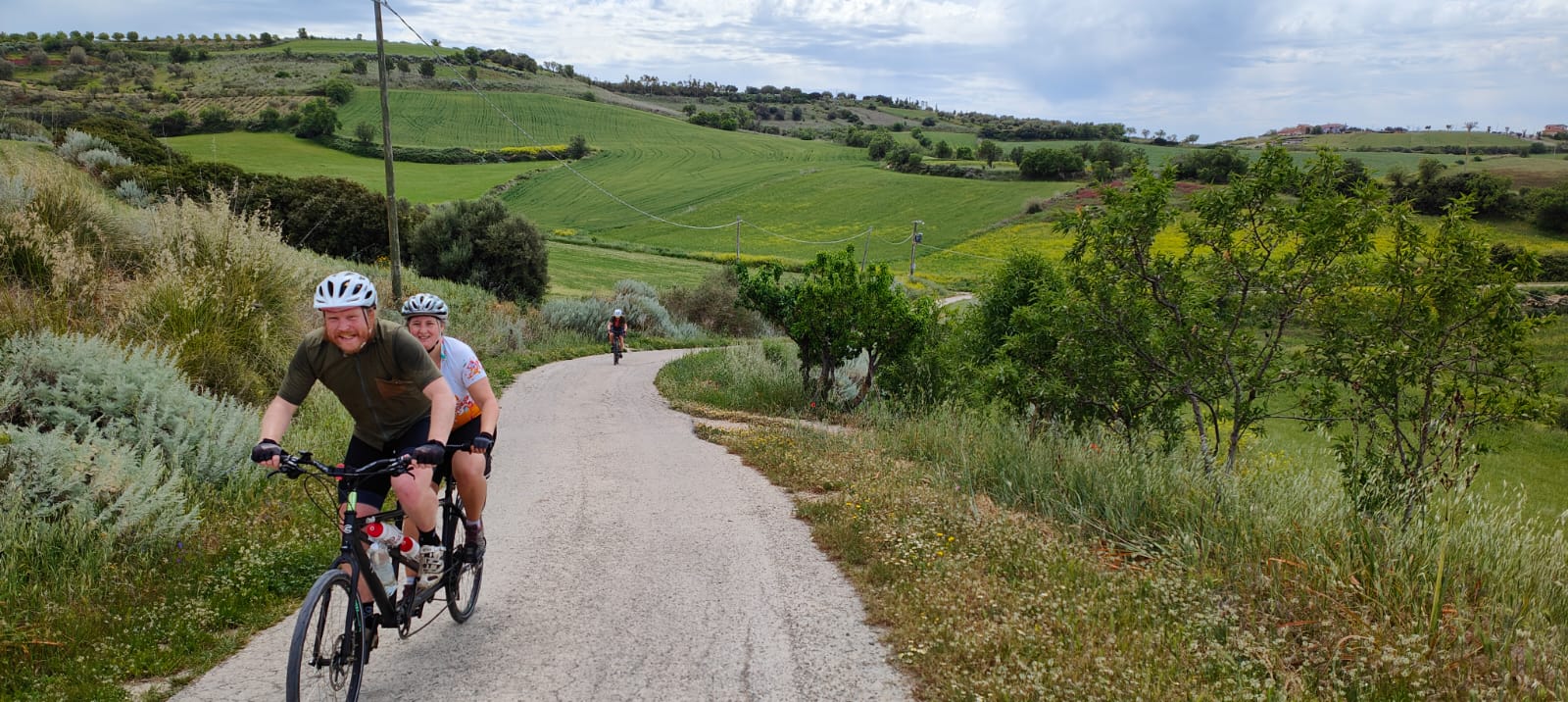
But…, If you can’t see what’s coming up, what do you do?
Yes, the person on the back, the stoker, can rarely see what’s coming up. They rely on the pilot to tell them everything that helps them cycle. This means, saying when bumps are coming up on the road, when we’re slowing down, when we’re turning and in which direction, what strength or power to give when pedalling, etc. It requires huge amounts of communication from the pilot and huge amount of trust from the stoker, to make tandem riding work.
Does it work okay when you’re fighting?
Umm… less so. Because good communication is SO important, it’s hard to cycle well when we’ve been arguing. One person commented that Robin wouldn’t be able to see all the faces I was making at him, and that’s true. But the up side, is I can’t see all the faces/ eyes rolling that he’s making at me – all annoyed faces are pointed in the same direction. 🤪
But… why? Why a tandem?
Well, why not? To be fair – Robin volunteers with a tandem club for those with a visual impairment, which means that tandem riding has been apart of our lives for about 4-5 years or so. (a plug for the tandem club – they are always looking for more pilots, if you’re strong, confident on a bike, and what to go out for longer rides 1-2 times a month please check out your local club)
The first time we thought about was reflecting on how much further and faster Robin can cycle on a solo bike compared to me. A lot of our rides would be him racing away and me slogging on at my own pace – not really spending time together. We were both frustrated with each other.
About 6 years into our relationship, I was assessed for a neurodiversity and eventually was given a name for why sometimes things are much harder for me to do. Dyspraxia is the slice of neurodiversity that I have. Dyspraxia can impact the coordination and motion processes functions between the brain and parts of the body. Dyspraxia can effect an individual’s ability to balance, perceive depth and speed, plan ahead what movement is needed to achieve a particular result. For me, dyspraxia affects many aspects of life, but when I’m cycling, I tire easily because there’s a lot for my brain to process when cycling – speed, depth, strength, distance, road/path surface, changing light intensity, balance, etc.
Two years ago, Robin and I rented a tandem bicycle to see what it would be like. It was amazing. It was definitely one of those life-changing, lightbulb moments when you know you’ll never look at the world the same. We came back from a 4 hour cycle and I still had energy to talk, stretch, help make dinner. If I’d been on a solo bicycle, I would have struggled to get in and out of the shower, and collapsed on the bed my body and mind totally spent. I had never before realised that it wasn’t a physical limitation/lack of fitness that meant I was unable to cycle long distances, but it was my brain and body getting tired by the coordination decision making and sensory overload.
And now we’re about to embark on this epic ride.
So please be kind to your neurodiverse family members, friends and colleagues, with some adjustments to the environment/context, we can do incredible things.

 Megan's blog