We did indeed make it all the way to the Black Sea – 3 weeks ago now.
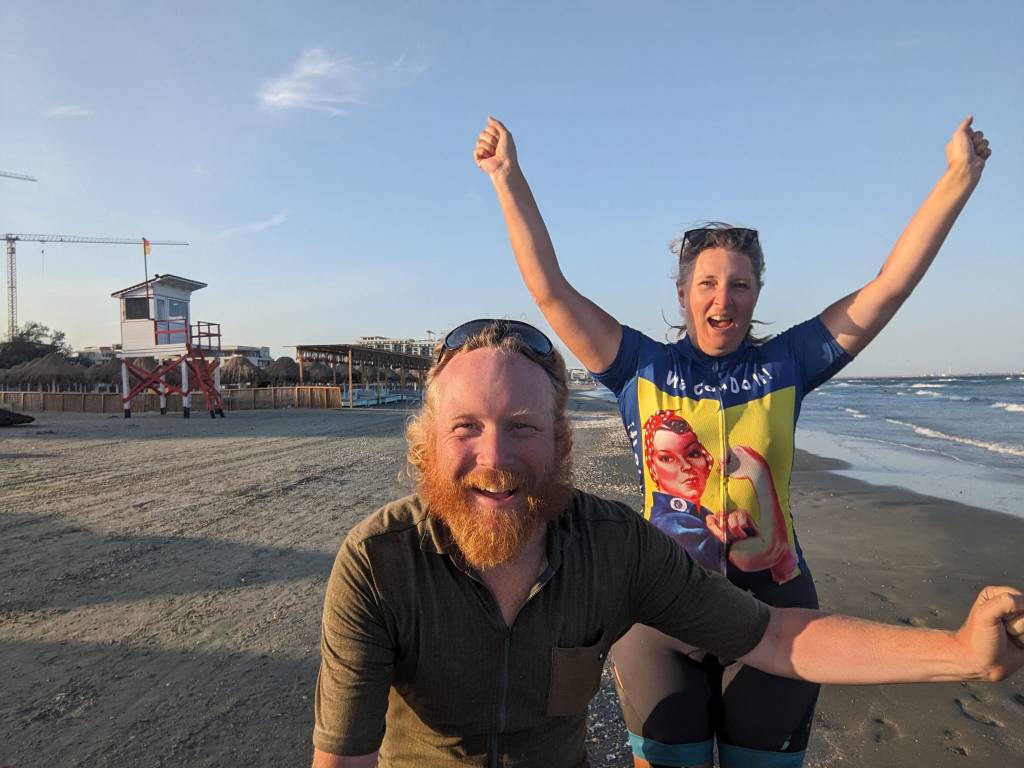
We had ambitions of going all the way to Istanbul but a tear in our tyre plus tiredness meant we stopped cycling once we reached Balchik in Bulgaria.
We arrived back in the UK on Saturday 23rd September, just over 10 weeks since we left the country. We’ve had a bit of time to do some reflections. Below is some of our cycling stats:
We had 59 days of riding, averaging 86km per hour per day.
We rode a total of 4,933.4km which we’re comfortably rounding up to 5,000km (although part of me will always look at this number and think ‘we only needed to ride for one more day to actually get 5,000km. Alas it wasn’t to be both us and the bike were knackered). And we climbed a total of 29,871 metres which is the equivalent of 3.4 Mt Everests.
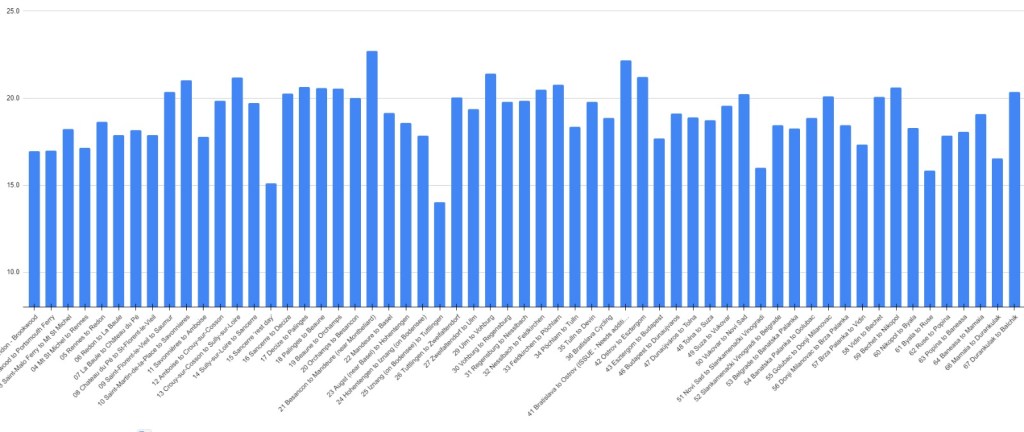
Our average moving speed was 19.3km per hour. Below you can see our average moving speed each day – the dips correspond with the hilly days.
Overall we visited 10 countries. Bulgaria, Austria and France were our favourites. France had the best camping, good cycling infrastructure and good food, Austria had great scenery, good camping (although more expensive than France) and good food, Bulgaria had the most variety in scenery, good food, good accommodation (less camping), TONS of history and felt the most adventurous. Picture below is from Bulgaria – some canyons and good roads.

Switzerland and Romania were our least favourite. In Switzerland it was expensive, bad cycling infrastructure and bad camping. Romania had almost no cycling infrastructure and we were always on busy roads, no camping and generally felt like hard work. The food was decent in Romania though.
We learned so much history – this was one of my favourite parts of the trip. Reading about different countries history, and seeing different characters show up in different countries. For example, Sigismund of Luxembourg was King of Hungary from 1387 but also Holy Roman Emperor from 1433. We met him first in Budapest as we read about the city’s history, then in Serbia when he was fighting for control of Golubac fortress from the Ottomans – he had to be saved by a knight and lady who were then awarded some land in Hungary which we’d stayed in the a few nights before. And then he showed up again in Bulgaria as we explored the fortress in Vidin, this was because of more territory wars, I think it was about expelling Bulgarians out of his Kingdom in Serbia.
We camped in Tulln, Austria, which was the location where European army gathered in 1683 before the Battle of Vienna and then defeated the Ottoman army. It’s this battle which is credited as the stopping point of Ottoman expansion into the rest of Europe. The Ottomans Empire in Europe, included most of what is today Bulgaria, Romanian, Serbia, Albania, Greece, Croatia, some of modern day Slovenia, Kosovo, Montenegro, Bosnia and Herzegovina, North Macedonia, Southern Ukraine and Crimea.
In Hungary, we passed the location of the Battle of Mochas, which is where in 1526, the Ottoman army first began to seriously threaten the Austrian-Hungarian Habsburg empire and also the Holy Roman Empire. The battle took place on a large swamp and the area is still swamp like, despite the changes the Danube has undergone. But it wasn’t until we got to Bulgaria that we we saw in remnants of Ottoman architecture, despite the most of Hungary, eastern Croatia, Serbia and Bulgaria being ruled by Ottomans for anywhere between 100 to 400 years. Part of the reason for this, we learned, is that during the many wars between the Habsburg and Ottoman empires they would both destroy the buildings and towns that each other had built up and rebuild them in their own architectural style. Budapest is a relatively new city, built in the 17th Century after the Habsburg’s retook the city from the Ottomans and rebuilt it in their style. By contrast, Edinburgh is a much older city than Budapest. I think if we traveled further south in Serbia, we would see more Ottoman style architecture but as I understand it, the Danube was the southern border for the Hungarian Habsburg empire. Picture below is Arabic inscription on the city gate walls of Vidin, Bulgaria.

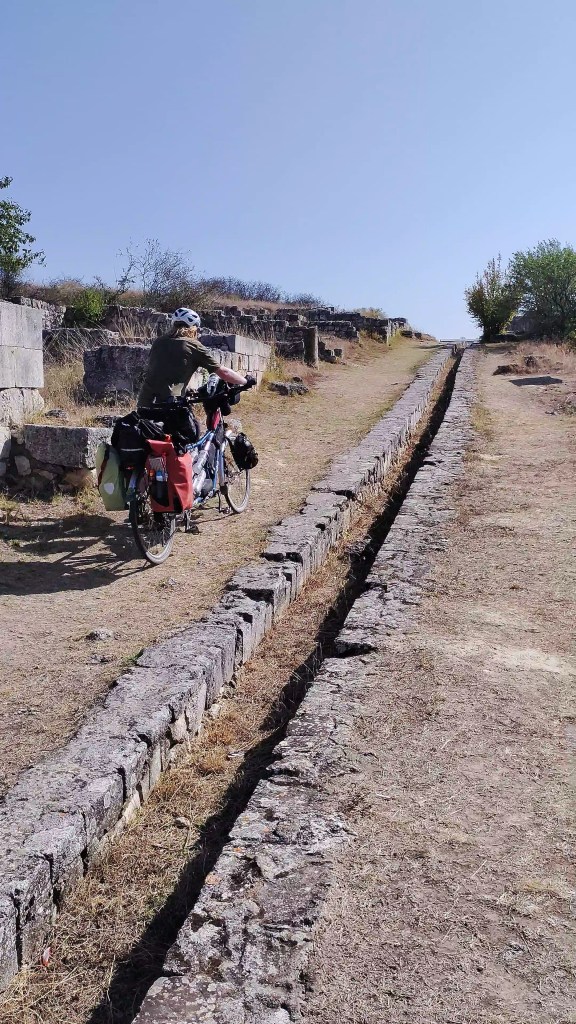
Likewise, the Danube was the northern border for the Roman Empire, and we saw TONS of Roman ruins especially in Bulgaria and Romania. Some were well excavated and others were just in the middle of some towns. We visited one ruin fortress in Romanian, and you could really imagine the old Main Street with its columns, sewage ditch, and shop fronts. The only other visitor this ruin had, besides us, was a tortoise.
In Bulgaria, we were cycling on a rough back road, over some hills and through the forest, and Robin comments that the locals call this the Roman road. I replied back that I thought it could be a Roman road, and Robin’s replied, ‘that Roman roads usually have ditches on either side of them’. I told him to look up from the road and pointed out the two dips on either side of the road in the forest about half a metre from the edge of the road on both sides.

And lots more – some more ancient history, and much newer history with WW2, USSR and break up of Yugoslavia. Fascinating beyond comprehension – part of me just wants to keep diving deeper and deeper into all of the history and its continued impact on the region.
I’m finishing up this blog back at our flat in Edinburgh, exactly 12 weeks since we started the journey in London. Forever changed and grateful for the experience and immensely proud of the achievement.


 Megan's blog