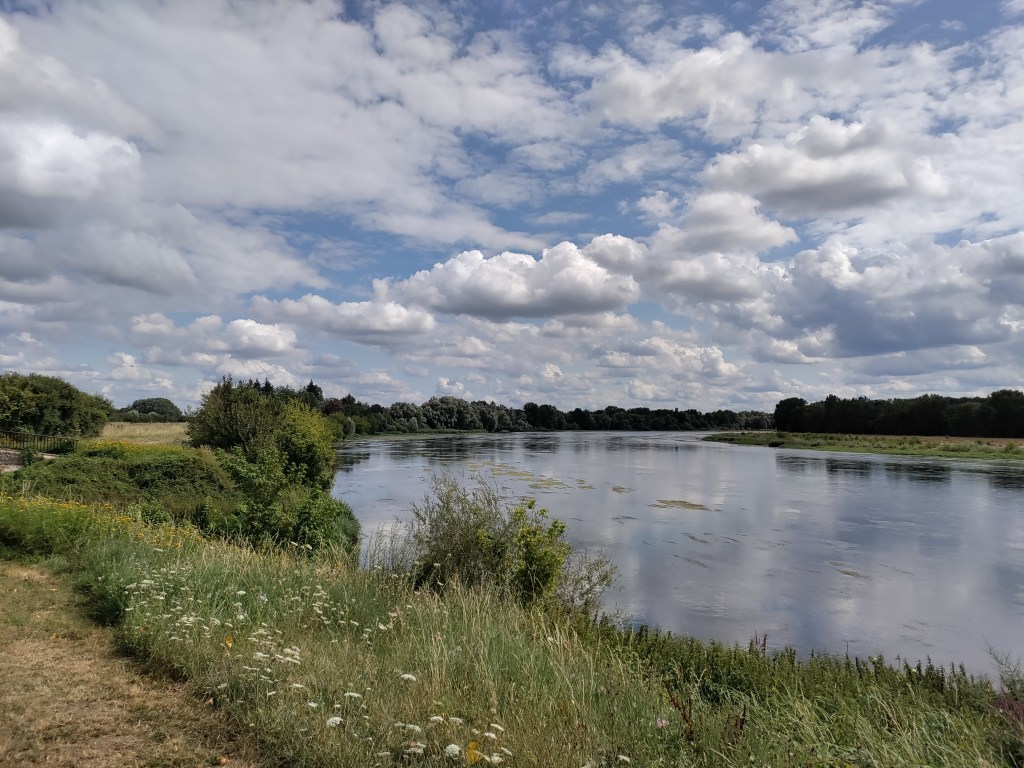
Given that we spent about 10 days next to Loire, we feel like it deserves a blog all on its own. Although we left the Loire on Saturday, which was 4 days ago, and feels like a long time in cycling terms.
We have seen many faces of the Loire. First as an estuary and at its widest point. We had to cycle over the bridge from St. Nazaire to St. Brevin, because the lift service for bikes doesn’t cater for tandems – our bike is too long. It’s a great service – we saw many families on the other side waiting to load their bikes onto the minibus’ trailer – so they can cross safely. On the bridge we had a small hard shoulder, so it wasn’t so bad, but it was high and felt scary in parts. The bridge is 3.3km long, 25% longer than our ‘home’ suspension bridge – the Forth Road Bridge.

But, back to the Loire, when it was an estuary, we saw many sea birds and sea marshes, but also traditional fishing huts, that are rented to local fisherman. They drop these big nets during high tide and catch fish such as plaice. It took us a while to work out when the Loire stopped being tidal – we realised it when we saw some cows drinking on its banks.

Another feature of the lowest reaches of the Loire is the modern art sculpture trail that has been developed along the river. Highly recommended. At the start of EV6 at the mouth, there is a giant skeleton of a serpent-like creature – when we were there hovering over the low tide, but other times it emerges from the surf. There’s also a melting yacht, that appears to be leaping down from a lock gate to the river below – apparently this is supposed to make us question whether objects have souls… We took a bumpy detour down a sandy path and found a troop of sculpted monkeys leaping between the trees. It all culminates at Nantes (another recommended city – seemed cool), which is home to a wonderful, steampunk mechanical elephant, 2 or 3 storeys tall, that blows steam and chases children.


The next few days, we saw the Loire, as a wide, shallow and sandy river. The river has many sandbanks and islands at this point. We wondered if this was the area of the Loire that dried up last summer, or if it’s always this way. Some of the campsites that we stayed in were on such islands.
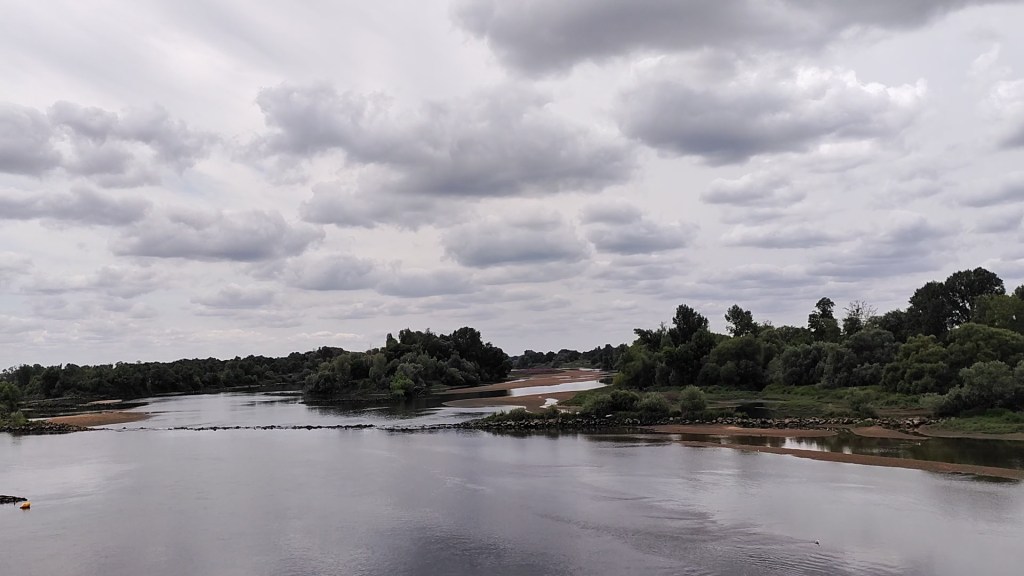
Every morning that we spent on the Loire, and most mornings since, we have seen dozens of herons, egrets and storks. As we followed the river, we mainly cycled on an embankment or next to agricultural fields. We were definitely always in the floodplain and never far from seeing fields of maize and/or sunflowers. We also saw wheat, hemp and orchards. Some days, we left the floodplains and climbed up to the hills to see the vineyards.

Next we followed the Loire as a canal (imaginatively named Canal Lateral du Loire), and here we saw more wildlife – nutrias and crayfish, both invasive species introduced from North America and kingfishers! We’ve lost count of the number of kingfishers we’ve seen. We also spent a few minutes watching black bass swimming catching their food in the currents. At one point an impressive canal aqueduct, built by the same Eiffel as the Eiffel Tower, carries the canal over the Loire itself, complete with wonderful 19th century lampposts.

Back on land we’ve seen deer and hares running across fields and foxes often with their big ears up listening to us. But the animals we’ve seen the most are birds, and particularly birds of prey. We are confident identifying that we’ve see buzzards, kestrels and kites. We’re fairly certain that we’ve seen hawks and some sort of falcons, but we couldn’t name them. We also spotted a Night Heron. We’ve turned into proper bird watchers, which we can thank the hours we spent playing wingspan (a very cool board game) this last winter. This means that we often can’t name the bird itself, but can tell each other how much it costs to play and what abilities it gives you in the game.

The other defining feature of the Loire was the many, many cyclists sharing the route with us. The standard greeting when passing other cyclists is ‘Bonjour!’ It doesn’t take long for this to get repetitive, and usually by the afternoon a nod of acknowledgement is also acceptable. Longer conversations finish with the excellent wish, “Bon route!” to your fellow travellers.
Cycling along the Loire is great – really easy, very well marked and lots of camping spots, wee villages for morning coffees, châteaus for touring, wineries for wine tasting, and picnic spots. Good for all ages – we saw LOTS of families and people of all ages enjoying this beautiful river.
For now, au revoir Loire.